The Question Every Business Traveller Actually Wants Answered
"Can I genuinely work on a private jet, or is it just marketing?"
This question comes up constantly from executives considering private aviation primarily for business efficiency. The promise sounds compelling: transform unproductive travel time into focused work hours, conduct confidential calls without nearby passengers overhearing, arrive at destinations having accomplished substantive work rather than just survived the journey.
But is it actually true, or is this aspirational marketing that doesn't survive contact with reality?
I decided to find out by actually testing work capability across five different private jet routes, using various aircraft types, and attempting the specific tasks business travellers actually need to accomplish during flights. Video calls with colleagues, document editing requiring reliable internet, confidential discussions about sensitive matters, and focused thinking time for complex problems.
Here's what actually works, what doesn't, and the honest assessment nobody provides before you book your first business flight expecting to be productive at 40,000 feet.
The Five Routes I Tested: Different Aircraft, Real Work Tasks
To properly assess working capability on private jets, I needed variety. Different aircraft types, varying flight times, and diverse connectivity systems. Here's what I tested.
Route One: London to Paris (Light Jet, 90 Minutes)
The classic European business route on a Cessna Citation CJ3, representing the light jet category that handles most short European sectors. I needed to complete a quarterly report requiring spreadsheet work, email responses, and one scheduled video call with my team.
The connectivity worked adequately for email and document editing. The WiFi struggled slightly with large file uploads but handled everything needed for standard business productivity. The video call quality proved acceptable, though not as crisp as office connections. My team could hear me clearly despite occasional lag.
The cabin noise level surprised me. Light jets are louder than larger aircraft, and conducting the video call required headphones to minimise background noise for participants. Not a dealbreaker, but worth noting if you're planning important calls where audio quality matters significantly.
The 90 minute flight time meant I accomplished exactly what I'd planned: report completed, emails cleared, call conducted. The compact cabin actually helped concentration by eliminating the option to wander about. You're sitting, working, with minimal distraction available.
"I was sceptical about working effectively on short European flights. The 90 minutes from London to Geneva produced more focused work than I typically accomplish in three hours at the office with constant interruptions." — Financial services executive, regular European traveller
Route Two: London to Geneva (Midsize Jet, 90 Minutes)
Same route duration, but aboard a Hawker 900XP midsize jet with notably better connectivity systems and quieter cabin environment. I scheduled two back-to-back video calls deliberately to test whether midsize jet connectivity could handle demanding real-time requirements.
The connectivity performed substantially better than the light jet. Video calls ran smoothly with minimal lag, and the cabin noise level meant I could conduct calls without headphones whilst maintaining audio quality for participants. The difference between light and midsize jets for connectivity-dependent work is significant.
The cabin space allowed me to move between seated work positions and a small conference table setup, creating subtle environment changes that helped maintain focus across the flight duration. This might sound trivial, but the ability to shift positions whilst remaining productive matters on longer sectors.
I also tested screen sharing during one video call, presenting a slide deck to colleagues in our London office. This worked adequately though not perfectly. Occasional lag interrupted smooth transitions, but the presentation remained functional throughout. Not office quality, but entirely usable for business purposes.
Route Three: Paris to Milan (Light Jet, 75 Minutes)
A shorter sector where I deliberately attempted focused writing rather than connectivity-dependent work. I needed to draft a complex proposal requiring concentrated thinking without distractions.
This is where private jets genuinely excel. The quiet cabin, absence of interruptions, and knowledge that I had exactly 75 minutes with nothing else demanding attention created ideal conditions for deep work. I produced more quality written content in that 75 minutes than I typically accomplish in a full morning at the office with email, calls, and colleague interactions fragmenting attention.
The psychological element matters: knowing the flight time is finite creates productive urgency. You have 75 minutes, there's nothing else to do, so you focus completely. Commercial flights never replicate this because the pre-flight stress, crowded environment, and constant service interruptions prevent genuine deep work.
Route Four: London to Nice (Midsize Jet, 100 Minutes)
This flight tested whether I could conduct a genuinely confidential discussion about a sensitive business matter. Three executives aboard, discussing potential merger considerations that required absolute privacy.
The private cabin environment delivered exactly what commercial aviation cannot: genuine privacy for sensitive discussions. We spoke freely without concern about neighbouring passengers overhearing, without lowering voices for confidential portions, and without the constant awareness that commercial environments require guarded conversation.
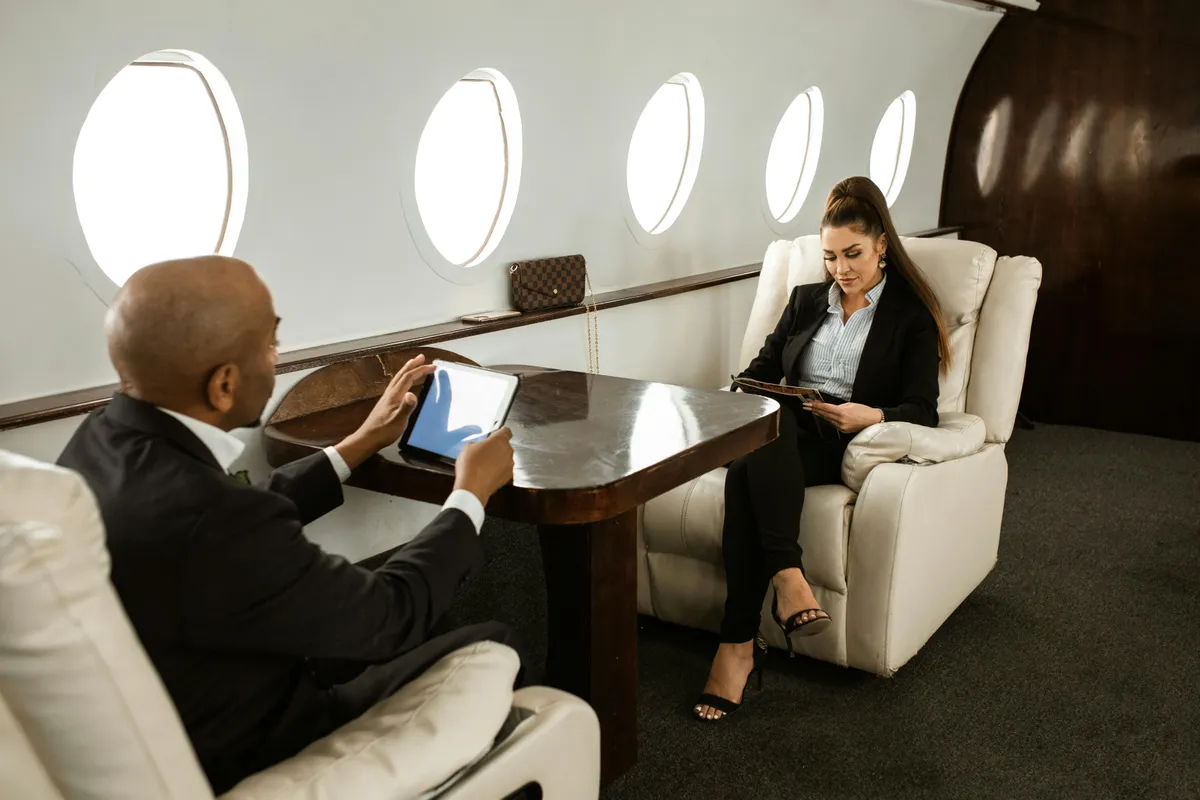
The cabin layout allowed us to sit facing each other around a small table, creating meeting room dynamics rather than the awkward side-by-side seating of commercial flights that makes substantive discussion difficult. The discussion remained focused and productive throughout the flight.
This scenario demonstrates private aviation's most significant business value for many executives. The ability to conduct genuinely confidential discussions during travel time that would otherwise be wasted creates value that's difficult to quantify but absolutely real.
Route Five: Frankfurt to London (Large Cabin Jet, 90 Minutes)
The final test involved a larger aircraft, a Bombardier Global 6000, representing the premium end of business jet capability. I wanted to understand whether the step up in aircraft size and systems created meaningfully better working conditions.
The connectivity was flawless. Video calls worked as reliably as office systems, large file transfers completed without issue, and the multiple connected devices I was using simultaneously all performed without bandwidth constraints. If your work demands genuinely reliable connectivity, large cabin jets deliver substantially better systems than light or midsize alternatives.
The cabin size allowed proper separation. I worked at one end whilst colleagues conducted their own calls and work at the other end, creating the privacy that commercial business class theoretically offers but rarely delivers in practice due to proximity to other passengers.
The cabin noise level was barely noticeable, allowing natural conversations without raised voices or straining to hear. For longer flights where you're working for multiple hours, this acoustic environment matters significantly for comfort and sustained concentration.
What Actually Works: The Honest Productivity Assessment
After testing work capability across these five routes and aircraft types, several clear patterns emerged about what genuinely functions well versus what remains challenging.
Email and Document Work: Universally Effective
Every aircraft I tested handled email and standard document work adequately. Whether light jet with basic WiFi or large cabin jet with satellite connectivity, you can confidently plan to clear email backlogs, edit documents, review presentations, and accomplish standard business productivity tasks.
The limiting factor is typically work surface and device screen size rather than connectivity. Aircraft tables are compact, and working on laptops in confined spaces creates ergonomic challenges on longer flights. Tablet work often proves more practical than laptop work for document review and email.
Video Calls: Aircraft Dependent
This is where aircraft type matters substantially. Light jets with basic connectivity handle video calls, but quality varies and bandwidth limitations become apparent if multiple devices are competing for connectivity. If video calls are central to your flight productivity plans, specify this requirement when booking and we'll prioritise aircraft with proven video call capability.
Midsize and large cabin jets generally handle video calls reliably, with quality approaching office standard. The key variables are cabin noise level, which affects audio quality for other participants, and bandwidth consistency, which determines video smoothness.
Pro tip: schedule video calls for the cruise portion of flight rather than during climb or descent. Connectivity often weakens during altitude changes, and cabin noise increases during these phases. The middle 60% of your flight provides the most stable working conditions.
Confidential Discussions: Private Aviation's Unique Strength
This is where private jets deliver value that no amount of commercial first class spending can replicate. The ability to discuss genuinely sensitive matters freely, conduct meetings requiring absolute discretion, and work on confidential documents without shoulder surfers creates business capability that commercial aviation simply cannot provide.
For executives handling mergers, executives managing personnel situations, or business leaders discussing competitive strategy, this privacy alone often justifies private aviation investment regardless of other productivity benefits.
Deep Thinking and Creative Work: Surprisingly Effective
One unexpected finding: private jets create excellent environments for focused thinking, strategic planning, and creative work that requires sustained concentration. The quiet cabin, finite time window, and absence of interruptions combine to produce conditions where deep work flourishes.
Several executives we work with specifically use flight time for strategic thinking they struggle to accomplish in office environments where constant interruptions fragment attention. The forced disconnection from immediate operational demands creates space for important but not urgent thinking that otherwise gets perpetually deferred.
The WiFi Reality: What You Actually Get
Let's address the connectivity question directly because this drives most business travellers' concerns about working aloft.
Understanding Private Jet WiFi Systems
Private jet connectivity falls into several categories with substantially different capability levels.
Air-to-ground systems use ground-based cell towers, providing connectivity over land but losing signal over water. These systems work well for European continental flights but fail on transatlantic routes or when flying over the English Channel, Mediterranean, or other water bodies. Bandwidth is typically adequate for email and document work but struggles with video calls.
Satellite-based systems maintain connectivity globally including over oceans, with bandwidth supporting video calls and multiple simultaneous users. Newer satellite systems provide genuinely reliable connectivity approaching office quality, whilst older systems offer more limited but still functional capability.
Aircraft age and operator investment matter significantly. A five year old aircraft with outdated connectivity systems performs markedly worse than a new aircraft with current generation satellite systems. When booking, ask specifically about connectivity type and capabilities if this matters to your productivity plans.
The Honest Bandwidth Limitations
Even the best private jet WiFi doesn't match office or home broadband speeds. Large file transfers take longer. Video streaming isn't practical. Cloud-based applications requiring constant connectivity sometimes lag.
However, the bandwidth typically proves adequate for standard business productivity: email, document editing, video calls, web browsing, and most cloud applications. The key is understanding limitations and planning accordingly rather than expecting unlimited bandwidth.
Connectivity Planning Recommendations
Download large files before departure rather than relying on in-flight downloads. Prepare documents offline to minimise cloud application dependencies. Schedule video calls for cruise portions of flights rather than during climb or descent when connectivity might weaken.
Test your specific work applications on your first private flight before assuming they'll work on subsequent flights. Some specialised business applications have connectivity requirements that exceed typical private jet capabilities. Understanding these limitations helps you plan realistically.
We advise honestly about connectivity capabilities when presenting aircraft options. If your work demands genuinely reliable video call capability, we prioritise aircraft with proven systems rather than defaulting to the most economical option that might not serve your actual requirements.
Private Jet Productivity vs Commercial Business Class Reality
Business travellers considering private aviation often compare working capability to commercial business class, their typical alternative. Here's the honest assessment based on actual productivity in both environments.
Commercial Business Class Working Reality
Commercial business class theoretically provides premium working environments with lie flat seats, power outlets, and WiFi connectivity. The practical reality proves less ideal.
The person beside you is two feet away. Any video call you conduct, they overhear entirely. Any documents on your screen, they can see with peripheral glance. Any confidential discussion, impossible. The theoretical privacy of business class fails immediately when you attempt actually confidential work.
Interruptions fragment concentration constantly. Service announcements, meal service, beverage carts blocking aisles, neighbouring passengers requesting aisle access, flight attendants checking meal preferences. What should be focused work time becomes fragmented attention barely more productive than economy class.
The boarding and deplaning processes waste time that the flight itself doesn't recover. You board 30 minutes early, often sitting on the tarmac. You wait for passengers to deplane after landing. The premium cabin provides comfort but doesn't eliminate these time wastes.
Private Jet Productivity Advantages
The working environment is genuinely private. Your team aboard the aircraft is the only group present. Confidential discussions happen freely. Sensitive documents stay confidential. The psychological difference of working in genuinely private space versus shared space affects productivity substantially.
Interruptions are minimal and controllable. Cabin crew attend to your specific needs rather than managing dozens of other passengers. If you need uninterrupted work time, you communicate this and receive it. If you want assistance, it's immediately available. You control the environment rather than adapting to it.
The time efficiency compounds productivity gains. Arriving 15 minutes before departure versus 90 minutes for commercial flights, boarding immediately versus waiting at gates, and departing/landing precisely on schedule versus commercial delays creates additional working time that commercial business class cannot match.
A typical London to Geneva business trip on commercial aviation loses 90 minutes to pre-flight arrival requirements, boarding delays, and arrival processes. That's 90 minutes you could have been working productively but instead spent managing commercial aviation logistics. Private aviation recovers this time entirely.
The Surprising Mental Clarity Factor
One finding I didn't anticipate when testing work capability across these routes: the psychological impact of private aviation on mental clarity and focus.
The Stress Reduction Element
Commercial aviation creates low-level stress even in premium cabins. Security queues, gate changes, boarding chaos, crowded terminals, delayed departures, all generate stress that you might not consciously notice but that affects mental state meaningfully.
Private aviation eliminates every stress source. You arrive relaxed, board calmly, and depart on schedule. The absence of travel stress creates mental space where clear thinking flourishes naturally. Several executives describe this as private aviation's most valuable but least discussed benefit.
The Forced Focus Window
Flight time creates finite windows where you cannot be interrupted by office demands, client requests, or operational emergencies. You're genuinely unavailable, which forces focused work on important but not urgent matters that otherwise get perpetually deferred.
This forced focus proves extraordinarily valuable for strategic thinking, complex problem solving, and creative work requiring sustained attention. The flight becomes dedicated thinking time that's difficult to create in normal office environments.
The Transition Buffer
Flying between important meetings on private jets creates natural transition time where you can mentally shift between contexts, review materials, and prepare properly. Commercial aviation's stress and distraction prevents this mental preparation, meaning you often arrive at critical meetings less prepared than you should be.
The quiet, focused environment of private jets allows you to review meeting materials, rehearse presentations mentally, and arrive at destinations genuinely prepared rather than just physically present.
When Private Jet Productivity Claims Are Oversold
Honesty requires acknowledging situations where private aviation's productivity benefits are oversold or don't materialise as marketing suggests.
Very Short Flights Under 60 Minutes
Flights shorter than 60 minutes provide limited productive working time once you account for climb, descent, and preparation. A 45 minute London to Amsterdam flight gives you perhaps 25 minutes of cruise time for focused work. This isn't worthless, but it's not transformative for productivity.
For very short routes, private aviation's primary benefit is time efficiency around the flight rather than productivity during it. You save time on airport processes, not work accomplished in the air.
Tasks Requiring Specific Office Resources
Some work genuinely requires office infrastructure that aircraft cannot provide. Printing documents, accessing secure servers requiring VPN connections that don't function well over satellite links, collaborative work requiring multiple screens and office meeting dynamics.
Understanding what work translates well to aircraft environments versus what genuinely needs office settings helps set realistic expectations. Not everything accomplishes effectively at altitude.
The Fatigue Factor on Longer Routes
Longer flights, particularly those exceeding three to four hours, create fatigue that affects concentration regardless of how comfortable the aircraft. The notion that you'll work productively for six hours straight on a transatlantic flight is unrealistic for most people.
Private aviation provides better environments for these longer flights than commercial alternatives, certainly, but it doesn't eliminate the fundamental reality that sustained focus becomes difficult after several hours regardless of environment quality.
Making Private Jet Work Time Actually Work
Based on testing productivity across these routes, here are practical recommendations for maximising work effectiveness when flying privately.
Plan Specific Work for Specific Flight Times
Don't just assume you'll "get some work done" during flights. Plan specifically what tasks you'll accomplish based on flight duration and connectivity capabilities. A 90 minute flight handles three to four substantive tasks effectively. Longer flights allow more ambitious work plans but require realistic expectations about sustained focus.
Front-Load Important Connectivity Work
If you have tasks requiring reliable internet, accomplish these during the cruise portion of flight when connectivity is most stable. Save offline work for climb and descent phases when connectivity might weaken.
Prepare Offline Backups
Download any files you might need rather than relying on cloud access. Prepare documents offline so connectivity problems don't completely derail productivity. This backup preparation ensures you can work productively even if connectivity underperforms expectations.
Use Flight Time Strategically
Match tasks to the aircraft environment's strengths. Flights excel at focused thinking time, confidential discussions, and work requiring sustained concentration without interruptions. They're less ideal for tasks requiring extensive collaboration, complex software, or activities demanding office infrastructure.
Communicate Your Work Plans
Tell cabin crew if you need uninterrupted time versus when you're available for service. This simple communication ensures the environment supports your productivity goals rather than inadvertently disrupting them.
We coordinate private aviation with business productivity as a central consideration, advising on aircraft selection, connectivity capabilities, and timing arrangements that support your specific work requirements. Whether you need reliable video call capability, confidential discussion environments, or simply focused time for strategic thinking, we ensure the aviation coordinates with rather than against your productivity goals.
Book your private flight now and discover how genuinely productive work at altitude transforms business travel from time lost to time invested.
For honest consultation about work capability on specific routes and aircraft types, contact us at [email protected] or [email protected]. We're available round the clock to discuss your productivity requirements and coordinate flights that actually deliver the working environment you need.
Image Attribution:
Photo by RDNE Stock project via Pexels, used under Pexels License.